“有教无类”
Hello, I’m Julien…
This page traces the personal trajectory behind my work. For a more traditional account of my experience and credentials, you can read my CV.
I grew up between cities. My parents divorced when I was seven, and for the next ten years I commuted every other weekend between Strasbourg and Paris. I learned early that holding a system together takes effort. I had to bear the strain of a fortnightly commute, with all the associated cost and infrastructure. And I had to carry the mental load of living across two worlds that were drifting apart.
Against the chaos of my nuclear family, I found anchors in my extended one. On my father's side, there were deep roots in Aigues-Mortes, in the Camargue. I remember gathering snails with my aunt, fishing in the canals of the saltworks where my uncle worked, or my cousin driving me to see the bull runs in nearby villages. On my mother's side, it was a network of supportive aunts and cousins, most of them strong and eccentric businesswomen. In short, I grew up understanding the strength of distributed networks, far more reliable than nuclear units. That model stayed with me.
My mother was a graphic designer running her own studio, and moved to the Caribbean when I was twenty, fulfilling her childhood dream of living in a warm place by the sea. She was always fiercely independent, and outsourced my childcare to an army of nannies. It was a set up I loved. One of those nannies, Danhan, was Chinese. She was among the first Chinese citizens to complete a PhD in France after the Cultural Revolution. I lost contact with her, and found her again online decades later. By then, she had become a director at the Chinese Development Bank in Africa. As a child, she taught me to eat with chopsticks. Retrospectively, she made me feel that China was not a world apart.
I was an academically brilliant kid, out of talent in part, but also necessity. Books gave me meaning, respite from my chaotic family, and a path ahead. If I could get into the right college, I would have a scholarship and independence. I entered Ecole Normale Superieure at twenty. Sitting at the top of the French Grandes Ecoles system of competitive entry colleges, ENS was established after the French Revolution to replace a beheaded aristocracy with one based on merit. Admission gave me something precious: a sense that I belong in any room. Privilege, arrogance, and ease, though I still have impostor syndrome like anyone else. The awards I later received in Australia served a similar function: after getting them, I could afford not to care, and think on my own.
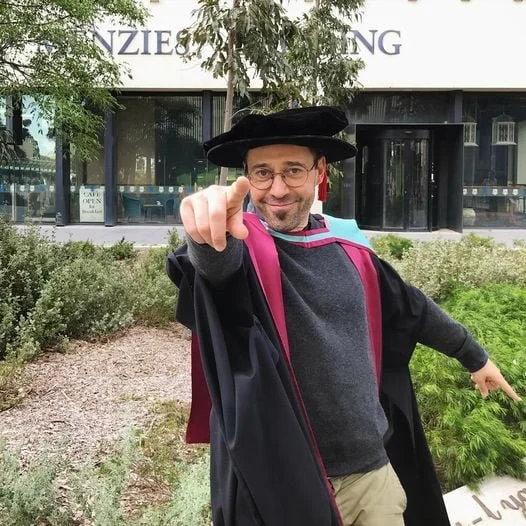
I submitted a first PhD in Paris, on collective nouns and collective agency. I was not allowed to defend it. Two jury members found it extended beyond disciplinary boundaries. I had already organised a long migration journey to Australia by then, and said no to staying on for another year and revising my thesis. I never wanted an academic career anyway. Still, there was a chip on my shoulder that drove a second PhD at Monash University, this one explicitly transdisciplinary, with an extraordinary supervisor, and was awarded in 2020. The research maps Chinese language learning as a distributed digital ecosystem, a field that doesn't quite experience itself as such, and a global public good in the making. It might be the most systematic expression of how I see most things: existing systems hold more coherence than they know, and are waiting for someone to reveal their structure, so they can gel better.
I migrated to Melbourne in 2008 by travelling overland from Paris to Singapore: three months of transition, discovering Asia, documented in a blog called Les Portes de l'Orient. I felt immediate familiarity when I first visited Melbourne: Mediterranean climate, coastal marshlands, Greek and Italian culture. There were also losses though. I had to sacrifice French so that I could integrate English more fully. As a writer, it was a gamble. I had deep connection to the French language, its cultural echoes and its syntactic precision. Good as it’s become, my English is rougher, but, it reaches further. I lost a measure of finesse, and in exchange, I gained a direct access to the global world.
I had been drawn to the Jesuits since I was young: their intelligence, their flexibility, their openness to other cultures. For a while, I considered a vocation to priesthood. I met my partner through Hospitality Club, the European precursor to Couchsurfing. Not only did we both value trust and hospitality, but he came from a lineage of Lutheran pastors and had been on a trajectory toward Taize monastic life before we met. In 2018, I completed the Ignatian Spiritual Exercises. It was clear then that priesthood was not my vocation. But just as clear was another one: to work on what is emergent and uncertain, helping things find their form. To a large extent, what I understood then has informed all my professional decisions since, and shaped my principles.
Coming out at twenty-one settled me in ways I hadn't expected. Love was possible. I briefly became an activist, president of the LGBTIQ group at ENS, and editor of the first French-language story collection with positive models for queer teenagers. Around 2003, I went to Ljubljana to help organise gay pride. I met Corin Ism, who later invited me to work at Global Challenges Foundation in Stockholm, and are now my primary professional partner. For me, queer life and priestly vocation have more in common than might appear. Both are about looking after the whole rather than just one's own. Also, they have protected me from any need to be mainstream. If I was a character in Lord of the Rings, I would be Galadriel: not the protagonist, but a key contributor to the plot.
I founded Marco Polo Project in 2011, after a scholarship took me to Tianjin and gave me the idea for a crowd-sourced digital magazine bringing Chinese intellectual voices to English-speaking readers. I co-founded the Future of Governance Agency with Corin Ism in 2019. I co-founded Shapeshifters Group with colleagues in 2024, an organisation giving voice and visibility to people who do the liminal work in organisations and ecosystems. All of those are expressions of a life in-between, seeking meaning, looking for coherence.
I live in Melbourne now, and spend weekends on long walks exploring all parts of the city. I write, I facilitate, I edit, I accompany. I work on what is emergent or uncertain, and help it find its form.